
Written & reviewed by Cory B., founder of NappyTi.me
Researched and fact-checked against peer-reviewed sleep studies, government health agencies (NIH, CDC), and established medical references (AASM, Sleep Foundation). Educational content — not a substitute for professional medical advice. See our editorial policy and methodology.
Why You Can't Fall Asleep — And How to Break the Loop
This guide is written for educational purposes using published sleep research and major medical references where possible. It is not medical advice. Review our editorial standards.
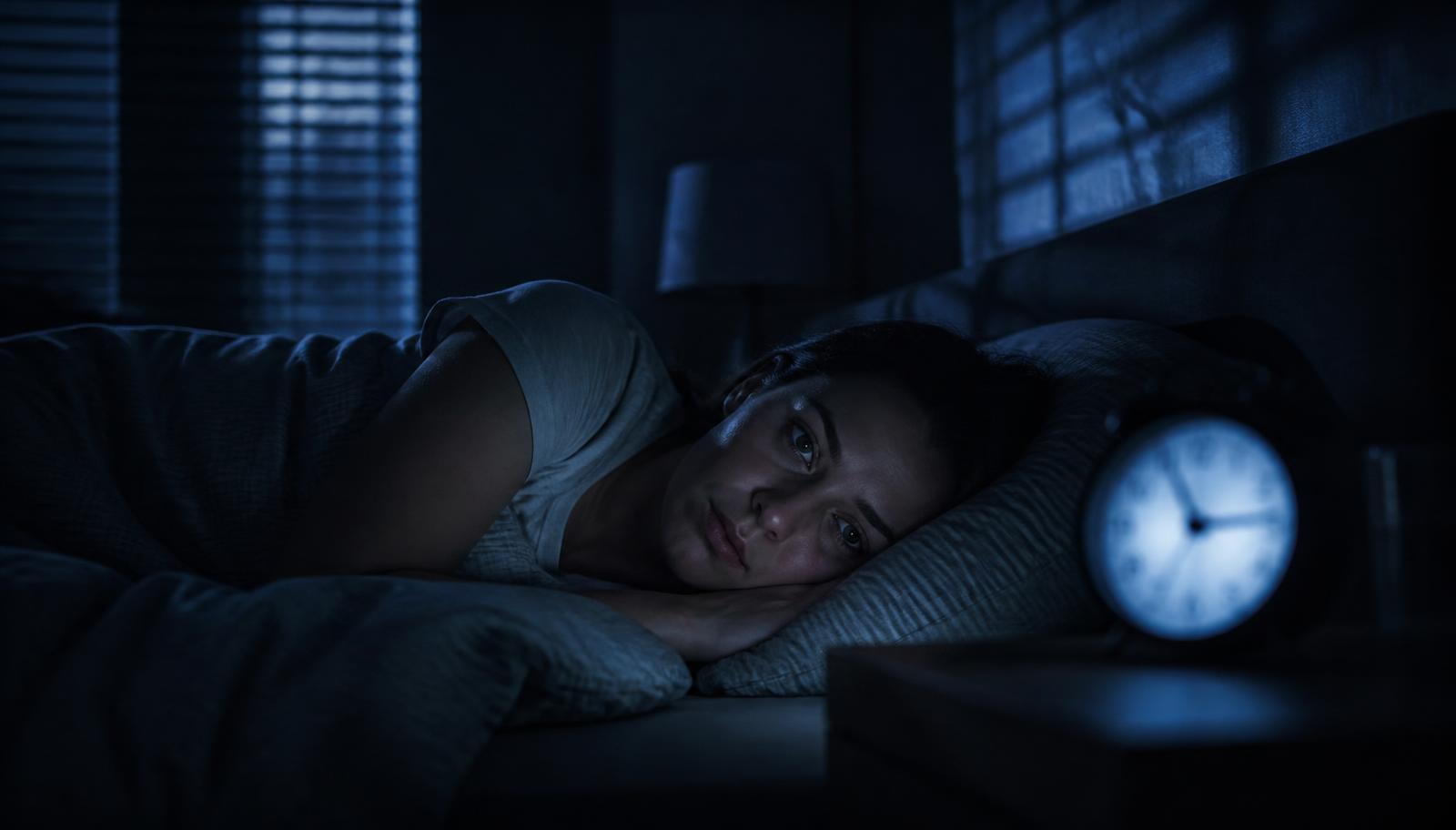
Almost everyone who searches "why can't I fall asleep" has already tried the obvious things: earlier bedtime, no phone, maybe melatonin. When those fail, the natural conclusion is that something is broken. Usually nothing is broken. Falling asleep is the output of two biological systems and one psychological one, and if any of the three is pointed the wrong way at 11 PM, no amount of lying still will produce sleep.
This guide walks through each of the three, in the order they most often cause trouble, and finishes with a two-week protocol that fixes the majority of cases without medication. Where a clinician is genuinely the right answer, it says so plainly.
1. Sleep pressure: you may not be tired enough yet
Adenosine accumulates in the brain during every waking hour and clears during sleep. That rising accumulation is what sleep scientists call homeostatic sleep pressure, and it is one half of Borbély's two-process model. The other half is the circadian alerting signal, an independent wake-promoting drive that rises through the afternoon, peaks in the early evening, and collapses in the small hours.
You fall asleep easily when pressure is high and the alerting signal has dropped. Three common habits break that alignment:
- Napping after about 3 PM. A late nap discharges hours of accumulated adenosine. A 45-minute nap at 5 PM can push sleep onset back by an hour or more.
- Going to bed before your body is ready. Compensating for a bad night by getting into bed 90 minutes early usually produces 90 minutes of lying awake, not 90 minutes of extra sleep.
- Caffeine you have stopped noticing. Caffeine blocks adenosine receptors, so pressure keeps building while you stop feeling it. Drake et al. (2013) found that 400 mg taken six hours before bed still measurably disrupted sleep — that is a 2 PM large coffee affecting an 8 PM bedtime.
The fix here is mechanical rather than psychological: protect the pressure. No naps after early afternoon, last caffeine at least eight hours before your target bedtime, and let yourself get into bed only when you actually feel sleepy. Our sleep cycle calculator gives you a bedtime window that lands on a cycle boundary instead of an arbitrary round number.
2. Circadian timing: your body clock may think it is evening
Your internal clock is set primarily by light hitting specialized receptors in the retina. Bright light in the two hours before bed delays melatonin release; bright light in the first hour after waking advances the whole system earlier. Chang et al. (2015) showed that reading on a light-emitting screen before bed suppressed melatonin, delayed its onset by roughly 90 minutes, and left readers less alert the next morning — even when total sleep time was held constant.
If you cannot fall asleep before 1 or 2 AM but sleep perfectly well once you do, this is almost certainly a phase problem rather than an insomnia problem. Delayed sleep phase responds to light, not to trying harder:
- Get 10–30 minutes of outdoor light within an hour of waking, every day. Overcast still works; through a window is far weaker.
- Dim household lighting to warm and low from 90 minutes before bed. Lamps beat ceiling lights; screen brightness matters more than colour temperature.
- Shift your target bedtime earlier in 15-minute steps, no faster than every second or third night. Larger jumps just recreate the lying-awake problem.
- Hold the wake time fixed while you shift. The wake time is the anchor for the entire system.
Read the full mechanism in Morning Light and Sleep, and if your schedule rotates, see Sleep for Shift Workers.
3. Hyperarousal: the part that makes it a loop
Riemann's hyperarousal model describes chronic insomnia as elevated physiological and cognitive arousal that persists into the night — faster heart rate, higher core temperature, more high-frequency EEG activity, and a mind that will not stop scanning. Crucially, arousal does not need a crisis to sustain it. Worrying about not sleeping is sufficient.
That is the loop, and it is remarkably consistent:
- A few bad nights, usually from stress, travel, or illness.
- Extra time in bed to compensate, which dilutes sleep pressure.
- More time awake in bed, so the bed starts predicting wakefulness.
- Anxiety about bedtime raises arousal before you even lie down.
- Onset gets slower, which confirms the fear.
The loop is learned, which is why the most effective treatment is behavioural. Trauer et al. (2015) found cognitive behavioural therapy for insomnia (CBT-I) reduced sleep onset latency by around 19 minutes and time awake after sleep onset by around 26 minutes, with gains that held at follow-up — and the 2021 AASM guideline recommends multi-component CBT-I as first-line care, ahead of medication.
The two techniques that do the heavy lifting
Stimulus control. The bed should mean sleep and nothing else. If you have been awake roughly 20 minutes and are clearly not drifting off, get up. Go to another room, keep the lights low, do something undemanding — paper book, folding laundry — and return only when sleepy. It feels counterproductive for the first three or four nights, then the association starts to reverse.
Sleep restriction (better described as sleep consolidation). Temporarily compress your time in bed to roughly the amount you are actually sleeping, with a floor of five and a half hours. Eight hours in bed producing six hours of sleep becomes a six-and-a-quarter-hour window. Sleep pressure rises, onset shortens, and the window is widened by 15 minutes once you are sleeping through about 90% of it. This is the most effective single component of CBT-I and also the least comfortable in week one.
Pair either with slow paced breathing to bring arousal down directly — the breathing tool runs a guided 4-7-8 cycle, and Breathing Exercises for Sleep covers why extending the exhale shifts autonomic balance toward rest.
The things that quietly sabotage onset
- Alcohol. It shortens onset and then fragments the second half of the night as it metabolises. Details in Alcohol and Sleep.
- A bedroom that is too warm. Core temperature has to fall for sleep to begin. Around 65–68°F (18–20°C) suits most adults; see Bedroom Optimization.
- Clock-watching. Every glance is an arithmetic problem about how little sleep is left, and arithmetic is arousing. Turn the display away.
- Late heavy meals. Digestion raises core temperature and reflux worsens when supine. Finish eating two to three hours before bed.
- Weekend drift. A two-hour Saturday lie-in is the equivalent of flying two time zones west and back. Consistency beats duration.
A two-week plan
Run this in order. Change one variable at a time so you can tell what worked, and log each morning with the printable 7-day tracker or the sleep journal.
- Days 1–3 — anchor the wake time. Pick one wake time you can hold seven days a week and get outdoor light within an hour of it. Do not touch bedtime yet.
- Days 4–6 — protect sleep pressure. Last caffeine eight hours before bed, no naps after 2 PM, no alcohol within three hours of bed.
- Days 7–10 — apply stimulus control. Out of bed after roughly 20 minutes awake, back only when sleepy. Expect the first two nights to feel worse.
- Days 11–14 — consolidate. Set time in bed to your average actual sleep plus 30 minutes (never below five and a half hours). Widen by 15 minutes after any two consecutive nights where you slept through nearly the whole window.
Most people see onset shorten noticeably in the second week. If you want a bedtime target that respects cycle boundaries while you do this, run your anchored wake time through the calculator.
When to see a clinician
Behavioural work is the right first move for most people, but it is not the right answer for everything. Book an appointment if any of these apply:
- Difficulty sleeping at least three nights a week for three months or more.
- Loud snoring, witnessed pauses in breathing, or waking gasping — screen for apnea.
- Crawling or restless sensations in the legs that improve with movement.
- Persistent low mood, anhedonia, or early-morning waking with rumination.
- Daytime sleepiness severe enough to affect driving.
None of this is medical advice, and NappyTi.me does not diagnose or treat sleep disorders. It is an explanation of the mechanisms and the behavioural tools that the evidence supports, so you can arrive at that appointment with two weeks of useful data instead of a guess.
Quick summary
- Onset needs high sleep pressure and a circadian signal that has already dropped.
- Late naps, late caffeine, and going to bed early all reduce pressure.
- Consistently late onset with good sleep afterwards is a light-timing problem.
- Chronic difficulty is usually a learned arousal loop; CBT-I techniques unlearn it.
- Fixed wake time is the single highest-leverage change available.
- Snoring, breathing pauses, or three months of disruption warrant a clinician.